
What Will You Read in This Blog?
- A clear understanding of what the IPv8 IETF draft actually proposes.
- Why full IPv4 compatibility might be IPv8’s biggest strength.
- How IPv8’s 64‑bit addressing works and how it compares to IPv4 and IPv6.
- The unified Zone Server architecture that integrates DHCP, DNS, authentication, and monitoring.
- The real controversy surrounding the draft – including AI‑generation speculation.
- The current status of the draft and what it would take to become a real standard.
- Our final verdict on whether IPv8 has a future in the networking world.
Introduction: A New Internet Protocol Sparks Global Debate
In mid‑April 2026, the IETF (Internet Engineering Task Force) received an Internet‑Draft that immediately ignited discussion across the networking community. The draft – submitted by Jamie (James) Thain – proposed Internet Protocol Version 8, or IPv8.
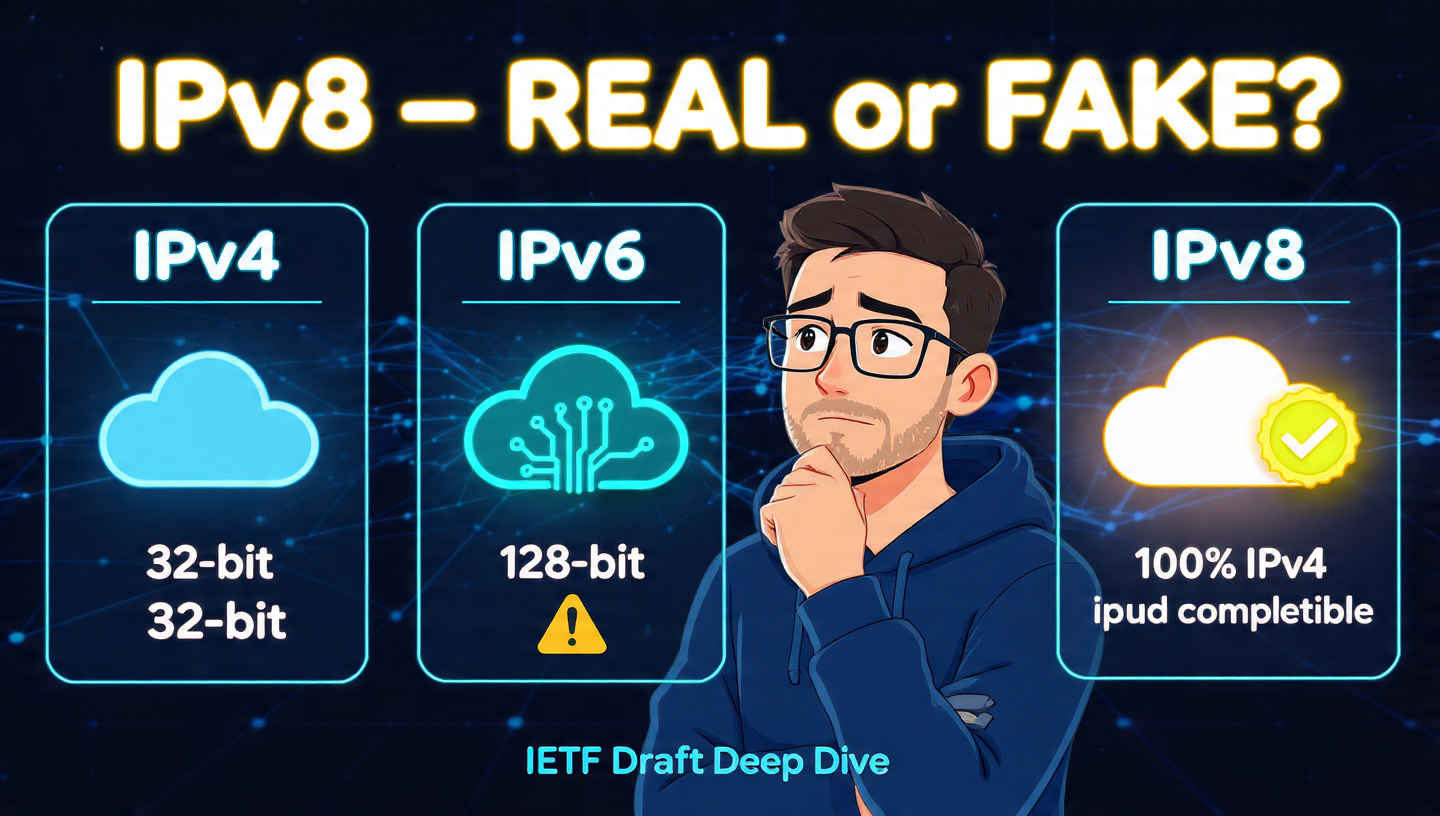
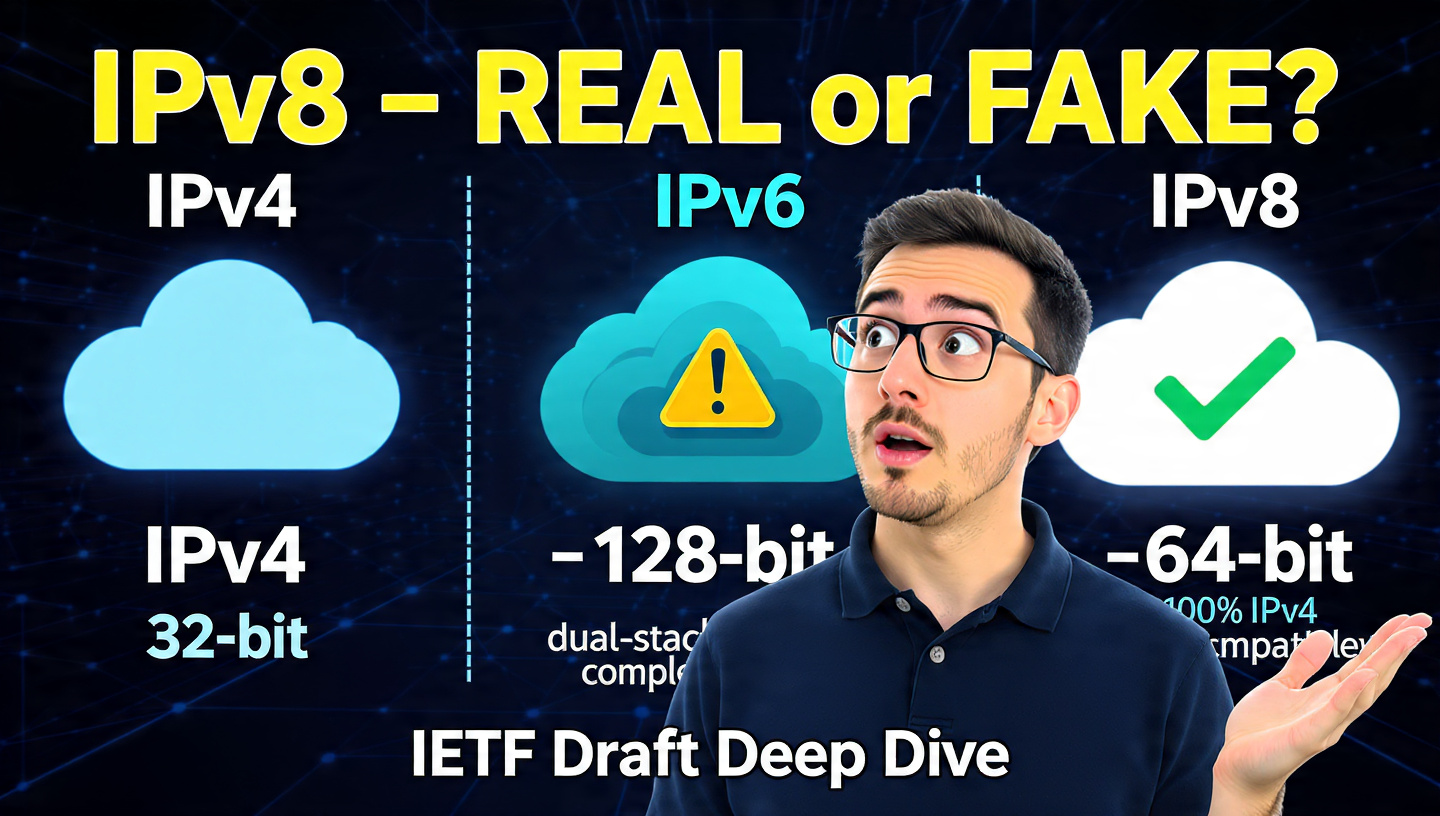
On paper, IPv8 promises something that IPv6 has struggled to deliver for nearly three decades: 100% backward compatibility with IPv4, a streamlined 64‑bit address space, and a unified management platform that integrates DHCP, DNS, authentication, telemetry, and access control into a single system. However, the proposal has been met with skepticism, and some analysts have even suggested that large portions of the document may be AI‑generated.
In this blog, we will go through the IPv8 draft step by step – exactly as we discussed in our video. We will examine its technical merits, its potential pitfalls, and what it would actually take for this draft to evolve from a personal submission into a real, deployable standard.
Why Do We Need Another IP?
Before diving into IPv8 itself, it is important to understand the problem it aims to solve.
IPv4 – the workhorse of the internet since the 1980s – uses 32‑bit addresses, providing roughly 4.3 billion unique IPs. With the explosion of smartphones, IoT devices, and cloud computing, we ran out of new IPv4 addresses years ago. Network Address Translation (NAT) and CGNAT have kept IPv4 on life support, but they introduce complexity and performance issues.
IPv6 was designed to fix addressing scarcity with a massive 128‑bit address space. However, after more than 25 years, global IPv6 adoption still hovers around only 40–50%. The main culprit? IPv6 is not backward compatible with IPv4. This forces network operators to run dual stacks (IPv4 and IPv6 simultaneously), which is expensive, complex, and error‑prone.
IPv8 enters this landscape with a bold promise: extend the IPv4 address space without breaking existing equipment.
IPv8: The Core Proposal
64‑Bit Addressing – The Sweet Spot
IPv8 uses a 64‑bit address space, which is double the size of IPv4 but half the size of IPv6. This provides roughly 18.4 sextillion (18.4 × 10²¹) addresses – more than enough for the foreseeable future.
The address format is expressed as eight octets (eight decimal numbers), often written as r.r.r.r.n.n.n.n.
How an IPv8 Address Is Structured
The IPv8 address is split into two 32‑bit parts:
| Field | Size | Description |
|---|---|---|
| Routing Prefix (r.r.r.r) | 32 bits | This typically represents an Autonomous System Number (ASN). Every ASN holder receives 4,294,967,296 host addresses. |
| Host Address (n.n.n.n) | 32 bits | This is semantically identical to a traditional IPv4 host address. |
In practice, this structure means that an IPv8 address might look like:
15169.8.8.8.8 – where 15169 is the ASN (Google’s ASN), and 8.8.8.8 is the traditional IPv4 address of Google’s DNS.
Full IPv4 Compatibility – The Killer Feature
One of the most powerful aspects of the IPv8 draft is that IPv4 is defined as a proper subset of IPv8. When the routing prefix is set to 0.0.0.0, the address automatically falls back to being a standard IPv4 address. This means:
- No existing device or application requires any modification.
- No forced migration (“flag day”) is required.
- Operators can gradually adopt IPv8 without turning off IPv4.
According to the draft, this form of compatibility could solve the single biggest roadblock that has hindered IPv6 adoption for decades.
Unified Network Management: The Zone Server Platform
Beyond addressing, IPv8 proposes a complete overhaul of how networks are managed. The Zone Server platform integrates multiple essential services into a single, coherent system:
| Legacy Service | IPv8 Equivalent |
|---|---|
| DHCP (address assignment) | DHCP8 |
| DNS (name resolution) | DNS8 |
| NTP (time synchronization) | NTP8 |
| Authentication | OAuth2 + JWT tokens |
| Telemetry & monitoring | NetLog8 |
| Routing validation | WHOIS8 |
| Address translation (IPv4⇄IPv8) | XLATE8 |
Under this model, a device joining an IPv8 network receives everything it needs in a single DHCP8 lease response – an IP address, a name, time synchronization, and access tokens. This unified philosophy could dramatically reduce operational overhead for campus networks, data centers, and ISPs.
Routing Enhancements: BGP8 and Beyond
The draft also specifies updated routing protocols to support IPv8, including BGP8, IBGP8, OSPF8, and IS‑IS8.
Under IPv8, the global routing table is structurally bounded – in theory, there would be no more than one routing entry per ASN. BGP8 also introduces a new metric called CF (Cost Factor), which is designed to produce better route selection by weighing multiple cost factors along a path.
The Other Side of the Coin – Where the Draft Faces Challenges
While the IPv8 draft is technically interesting, it has generated considerable controversy within the networking community.
Speculation About AI Generation
Several community members have raised concerns that the document appears to be largely AI‑generated. Using AI‑detection tools such as GPTZero, some analysts have reported that significant sections of the draft show patterns consistent with large language model output. The author also published multiple revisions and related documents in a very short time frame, which has further fueled this speculation.
The Author’s Background
Jamie (James) Thain, the author of the draft, is listed as being associated with One Limited, a company registered in Bermuda. His professional background in networking is not widely known, and many community members have been unable to verify his previous contributions to protocol development.
The Draft Has Not Been Approved by IETF
It is important to note that this is an individual Internet‑Draft. IETF explicitly states that “Anyone may submit an I‑D to the IETF. This I‑D is not endorsed by the IETF and has no formal standing in the IETF standards process”. The draft is valid for only six months and may expire without ever becoming an RFC.
Billions Already Invested in IPv6
A more practical challenge is that the networking industry has already invested billions of dollars in IPv6 over the past 25 years. Many major ISPs, content providers, and enterprises have deployed IPv6 extensively. Convincing them to abandon that investment and migrate to yet another new protocol would be an enormous uphill battle.
Current Status of the Draft (April–October 2026)
The IPv8 draft entered the IETF system on 14 April 2026 and will remain active until 19 October 2026. During this window, the draft is open for public review and discussion. Community sentiment so far – as seen on NANOG, Hacker News, and IETF mailing lists – has ranged from curiosity to outright dismissal. At the time of writing, there is no indication that the IETF intends to adopt this draft as a Working Group item.
Final Verdict – Should Networking Professionals Pay Attention?
From a purely educational perspective, the IPv8 draft is worth reading because it forces us to think critically about the trade‑offs between compatibility, address space, and manageability. The idea of using ASN + IPv4 as a new addressing scheme is genuinely interesting.
However, from a practical deployment standpoint, IPv8 faces enormous hurdles:
- The draft is an individual submission with no IETF endorsement.
- There are significant questions about the document’s origin and the author’s background.
- The industry has already committed deeply to IPv6, and a new protocol would face massive resistance.
- The proposed unified management model, while elegant, would require replacing or upgrading virtually every network device in existence.
In our view, the IPv8 draft is best understood as an interesting thought experiment rather than a realistic candidate to replace IPv4 or IPv6. It highlights legitimate frustrations with IPv6 deployment, but it does not offer a clear migration path that the industry is likely to accept.
Disclaimer
This blog is for educational and informational purposes only. The IPv8 draft is an individual Internet‑Draft submitted to the IETF. It is not an Internet standard, and it is not endorsed by the IETF, any working group, or any official standards body. All views expressed in this blog are intended to help readers understand the draft’s content and context. Readers are strongly encouraged to review the original draft documents available on the IETF Datatracker before drawing any conclusions.
This blog is based on our original YouTube video “IPv8 IETF Draft Explained”. If you enjoyed this content, please share it with your networking peers and leave your thoughts in the comments section below.
Read More here: Blogs
 Dev Gundalia