


What You’ll Read in This Blog
- Why millions are searching “Is WW3 coming?” in 2026
- The key global flashpoints worrying analysts most
- What the Doomsday Clock indicates now — and its significance
- Balanced views from experts on WW3 predictions
- Nuclear war risks in 2026: The factual assessment
- The Verdict: How close are we to WW3?
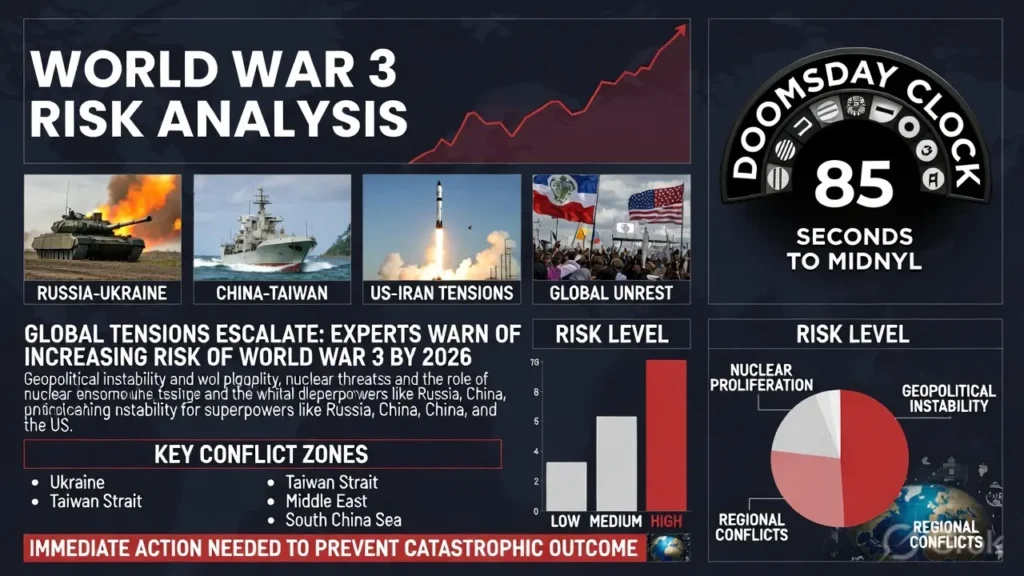
Why Millions Are Asking This Question in 2026
The query “Is WW3 coming” continues to spike on search engines, driven by ongoing wars and recent escalations. Polls across Western countries show growing public anxiety: nearly half of Americans believe a new world war is likely by 2031. Similar sentiments echo in the UK, France, and Germany, where majorities see the world as increasingly dangerous. Ukrainian President Zelensky has even stated that Putin has already started WW3.
This fear stems from a confluence of crises: the protracted Russia-Ukraine war, heightened US-Iran tensions following recent strikes, and persistent China-Taiwan standoffs. Add to this the erosion of arms control treaties like New START, which expired in February 2026, and advances in disruptive technologies like AI, and the global landscape feels precarious.
| Stat | Value | Description |
|---|---|---|
| 4+ | Active major conflict zones globally in 2026 | Including Ukraine, Middle East, potential Taiwan |
| 85s | Seconds to midnight on the Doomsday Clock (2026) | Closest ever, per Bulletin of Atomic Scientists |
| 9 | Countries with nuclear weapons | Risk of proliferation rising |
The Key Global Flashpoints Worrying Analysts Most
1. Russia and Ukraine. The conflict, now in its fourth year, involves indirect NATO support, raising fears of broader involvement. Experts warn of potential NATO-Russia clashes as a high-impact risk. Russia’s grinding campaign continues, with no end in sight, and Putin aiming for outright victory.
2. China and Taiwan. Beijing’s military exercises and US commitments create a volatile situation. While no invasion is predicted imminently, tensions could escalate rapidly, especially around the Kinmen Islands. Analysts see 2027 as a key year, but 2026 drills heighten risks.
3. The Middle East, including US-Iran. Recent US strikes on Iran amid nuclear deal failures have heightened risks. Proxy conflicts involving Israel, Hamas, Hezbollah, and others form a complex web that could draw in major powers. Fragile ceasefires in Gaza add to the powder keg.
Important Context: While these flashpoints are serious, historical precedents like the Cold War show that deterrence and diplomacy can prevent full-scale war. Not all tensions lead to global conflict.
What the Doomsday Clock Is Telling Us
The Bulletin of the Atomic Scientists set the Doomsday Clock at 85 seconds to midnight in January 2026, the closest ever, citing nuclear risks, climate change, AI, and biological threats. This symbolic gauge, maintained by Nobel laureates and experts, underscores the urgency for international action.
The move from 89 seconds reflects failures in leadership on arms control, with New START expiring and proliferation threats rising. It’s a call to address these existential dangers promptly.
Balanced Views from Experts on WW3 Predictions
Mainstream analysts from the Council on Foreign Relations and RAND do not predict WW3 as imminent but highlight the highest risk of miscalculation since the Cold War. The concern is chain reactions from crises, not deliberate global war.Dr. John Mearsheimer warns great power competition increases conflict likelihood over time.
Conversely, others like Steven Pinker note declining interstate warfare due to institutions and interdependence. Fiona Hill argues WW3 has already begun in a fragmented sense. Texas A&M experts deem full WW3 unlikely, though China-US tensions could escalate down the road.
Is Nuclear War a Real Risk in 2026?
The honest answer: the risk is low in absolute terms but higher than in decades.
Russia has lowered nuclear thresholds in Ukraine context, North Korea advances missiles, and New START’s expiration sparks arms race fears. Proliferation risks grow in Iran, potentially South Korea, Japan, Saudi Arabia.
Deterrence has held for decades, but deteriorating communications challenge rational actor assumptions. Experts call for broader arms control measures.
The Verdict
The world is more dangerous than a decade ago. Multiple conflict zones, fraying nuclear frameworks, and deteriorating diplomacy shrink error margins. But World War 3 is not inevitable; history shows diplomacy prevails in dark times.
Stay informed via credible sources like Reuters, BBC, CFR. Awareness fosters action, not panic.The most important action: support diplomacy and reliable information over sensationalism. The human desire to preserve progress remains a powerful force.
Editorial Disclosure: This blog post is for informational purposes only. All claims are based on publicly available reporting and analysis from verified institutions. No content is intended to cause undue alarm or spread misinformation. This site complies fully with Google Search, Google AdSense, and Google Analytics content policies. No affiliate links are present. Sources include Bulletin of the Atomic Scientists, Council on Foreign Relations, and major academic institutions.
For more upates follow: https://www.instagram.com/global_ledger_/
Drop a comment below: What do you think this leads the world!
Read More Sports here: News