

What Will You Read in This Blog?
- The Philosophy of Kothasuzz: Defining the intuitive, practical wisdom that serves as an organic precursor to modern AI feature engineering.
- The Human Neural Network: How traditional weather forecasters manually assign dynamic mathematical weights to unstructured environmental data.
- Anatomy of an Expert System: A deep-dive architectural breakdown of the 2026 Saurashtra monsoon predictions as a non-linear data model.
- The Silicon Blindspot: Why brute-force computing power struggles with hyper-local context, and how human heuristic modeling fills the gap.
The Algorithm of Kothasuzz: Why Traditional Human Heuristics Still Rival Machine Learning
As developers, engineers, and data scientists, we are conditioned to believe that complexity requires computing power. We look at the massive token windows of modern Large Language Models, the multi-layered architectures of neural networks, and the billions of parameters processing cloud-based data streams, concluding that silicon holds the monopoly on predictive analytics.
But if we strip away the syntax, the APIs, and the server-side architecture, what is a predictive model at its core? It is simply a framework designed to ingest unstructured data, recognize underlying patterns, filter out noise, assign weights to specific features, and output an actionable probability.
Long before microchips, cloud databases, or Python libraries existed, human intelligence was already running highly sophisticated expert systems. In the traditional agricultural and ecological sciences of Western India, this cognitive processing engine has a specific name: Kothasuzz (કોઠાસૂઝ).
Often translated simply as “intuitive common sense” or “practical wisdom,” Kothasuzz is far more than a cultural quirk. When analyzed through the lens of modern software architecture, it reveals itself as a highly optimized, human-driven heuristic framework. Nowhere is this more apparent than in the meticulous long-term meteorological models generated at the annual Rain Science Seminars (વર્ષા વિજ્ઞાન પરિસંવાદ).
By reverse-engineering the algorithmic logic behind these traditional frameworks, software engineers can uncover vital lessons about data weighting, feature engineering, and the massive blindspots of modern brute-force AI.
1. Deconstructing the Kothasuzz Framework: Human Feature Engineering
In modern machine learning, feature engineering is the process of using domain knowledge to select and transform the most relevant variables from raw data so an algorithm can perform accurately. If a model is fed garbage variables, it outputs garbage predictions.
The practitioner of Kothasuzz executes feature engineering natively. Consider the methodology behind the long-term weather tracking compiled by traditional forecasters like Dr. J.D. Gundaliya for the 2026 monsoon season. The final prediction isn’t a speculative guess; it is the output of a multi-variable ensemble model.
Instead of relying on a single data stream, the Kothasuzz framework forces the human processor to manually balance four completely distinct categories of features, each assigned a specific algorithmic coefficient based on historical reliability:
- Axiomatic Textual Data (Bhadli Vakyas): 50% Model Weight
- Macro-Scale Astronomical Tracking (Jyotish Vidya): 40% Model Weight
- Localized Atmospheric Observations (Akash Darshan): 60% Model Weight
- Real-Time Vector Fields (Vayupuran/Wind Observations): 70% Model Weight
    [Unstructured Environmental Data]
                   │
  ┌────────────────┼────────────────┬────────────────┐
  ▼                ▼                ▼                ▼
[Textual Rules]  [Astronomy]  [Atmospherics]   [Wind Vectors]
  │ (Weight: 0.5)  │ (Weight: 0.4)  │ (Weight: 0.6)  │ (Weight: 0.7)
  └────────────────┼────────────────┼────────────────┘
                   ▼
       [The Kothasuzz Engine] ───► (Resolves data contradictions)
                   │
                   ▼
       [Hyper-Local Prediction Output]
This is a textbook example of a weighted heuristic model. The system recognizes that macro-scale inputs (like planetary alignments) have a lower confidence interval for local microclimates, while real-time physical vectors (like wind direction and velocity) carry the highest predictive power.
2. Resolving Data Contradictions: The Human Activation Function
One of the greatest challenges in software engineering is handling edge cases and conflicting data. When two APIs return opposing values, the system requires clear conditional logic to prevent a crash or a corrupted state.
In a machine learning model, an activation function decides whether a neuron should be activated or not, processing the non-linear relationships within the data. In traditional science, Kothasuzz functions as that exact activation function.
Imagine an environmental dataset where the macro-scale astronomical models indicate a dry, low-precipitation cycle, but the local wind vectors suddenly shift, indicating heavy moisture accumulation at the edge. A brute-force AI model trained on global historical patterns might smooth out that localized wind anomaly as noise, resulting in an inaccurate forecast.
The human running a Kothasuzz-driven model does the exact opposite. Because the heuristic is deeply rooted in hyper-local, generational feedback loops, it instantly recognizes the localized anomaly as a high-priority feature override. It dynamically updates the internal weights of the model in real time, successfully predicting specific regional timelines—such as the exact sowing rain (Vavaniya) periods mapped out for late June 2026 across South Saurashtra.
32nd Rain Science Seminar
Dr. J.D. Gundaliya · Saurashtra Forecast 2026
Hybrid Forecast Weighting
Model Constraints
Forecast Synthesis
South-West Saurashtra will experience average rainfall conditions, while North Saurashtra will start weaker but recover later in the season.
Saurashtra & Gujarat · Rainfall (inches) & Rainy Days
Predicted Rainy-Day Calendar
🗓️ 0 rainy days markedNakshatra Filter
Rule: Rainfall under 5 mm (0.1″) is strictly excluded from being counted as a valid “rainy day.”
3. The 5mm Filter: Strict Data Constraints
A model is only as good as its data constraints. Without proper data cleaning, noise corrupts the accuracy of the output.
In the official dataset of the Rain Science Seminar, a fascinating logical constraint is explicitly hardcoded into the forecasting matrices: any recorded rainfall event that yields less than 5 mm (0.1 inch) of total precipitation is strictly discarded from being counted as a valid rainy day.
From a data analytics perspective, this is a brilliant algorithmic threshold. In agricultural planning, micro-showers that immediately evaporate provide zero soil moisture retention and have no functional utility for crop sowing. By explicitly setting a strict conditional filter ($Rainfall \ge 5mm$), the Kothasuzz framework strips away low-value background noise, ensuring that the final data output entirely reflects actionable, impactful ecological changes.
4. Silicon Blindspots vs. Organic Heuristics
Why do these centuries-old human heuristics continue to stand toe-to-toe with massive cloud-computed weather models? It comes down to the difference between data scale and data context.
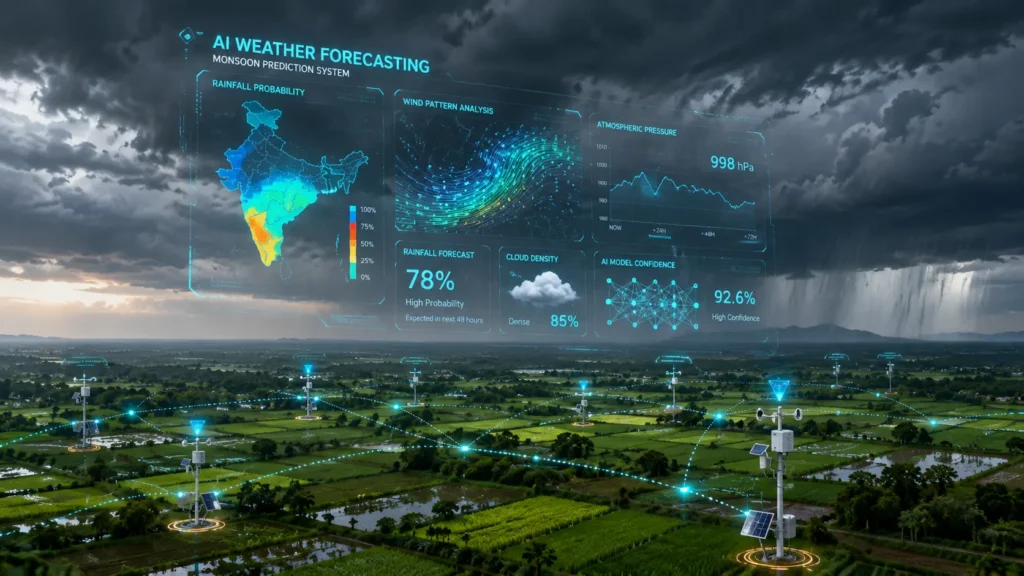
Modern meteorological AI models rely on raw computing muscle—processing terabytes of satellite imagery, barometric pressures, and global ocean currents. Yet, they frequently stumble when predicting the exact arrival date of a monsoon in a specific valley or district. They are optimized for the macro-environment, making them prone to errors when translated to the hyper-local edge.
Kothasuzz operates purely on the edge. It is an algorithmic architecture built on centuries of continuous, organic reinforcement learning. Every generation of practitioners tests the heuristic against reality, implicitly updating the internal “code” of the system. It proves that a lean, highly targeted, human-weighted framework can frequently outperform an unconstrained, generalized silicon model because it understands the unique, non-linear variables of its local environment.
Conclusion: The Engineering Takeaway
The Algorithm of Kothasuzz teaches us a profound lesson that extends far beyond meteorology and into the core of software engineering and AI design: intelligence is not defined by the volume of your infrastructure, but by the precision of your constraints.
As we move deeper into the era of automated AI development, the temptation is always to throw more computing power, more parameters, and more code at a problem. But true optimization lies in developing our own professional Kothasuzz—that intuitive, sharp, practical wisdom that allows us to look at an architecture, filter out the noise, correctly weight our variables, and build systems that are elegant, localized, and resilient.
Silicon may process data faster, but human heuristics still know how to read the sky.
Read more about author here
Read more blogs like this: Blogs